Strength
Strength Training for Beginners at Home (No Equipment Needed)
Short answer
Beginners can build real strength at home with no equipment by doing a short routine of bodyweight movements — squats, hinges, push-ups, rows, lunges, and carries — two or three times a week, and making each one slightly harder over time. Start with a version you can do well, and progress when it feels easy.
Before you start
This is the routine I'd give a brand-new client on day one if I couldn't be in the room. It's the same movement patterns I use in in-home sessions — squat, hinge, push, pull, single-leg, carry, and core — done with your bodyweight and household objects. If you're in North Dallas and want these coached in person, that's my beginner fitness coaching. If you're reading from anywhere else, this will get you going.
Talk to your physician first if you have a health condition, are pregnant or postpartum, or have an injury. This is general education, not medical advice.
What you need: a clear space about the size of a yoga mat, a sturdy chair, a wall, and something to carry (a loaded backpack, a jug of water, a bag of groceries).
The rules that matter
- Do the easiest version well before the harder one. Form first, always.
- Stop a set with one or two reps "in the tank." You should never be grinding on the last rep as a beginner.
- Train two or three days a week, not on back-to-back days. Federal guidelines call for muscle-strengthening activity at least two days a week (CDC). Two is enough to progress.
- Make it a little harder every week or two. More reps, a harder version, a slower tempo, or less rest. That's progressive overload, and it's the whole game.
- Soreness is normal for the first two weeks. Pain is not. Sharp or joint pain means stop and adjust.
The routine
Warm up with 3–5 minutes of easy movement: march in place, arm circles, hip circles, a few slow bodyweight squats to a chair.
Then do the following as a circuit — one set of each, in order, rest a minute, repeat. Beginners: 2 rounds. After two weeks: 3 rounds.
| # | Movement | Pattern | Start here | Progress to |
|---|---|---|---|---|
| 1 | Squat to chair | Squat | 8–10 reps, sitting fully to the chair | Touch-and-go, then bodyweight squat without the chair, then holding a backpack |
| 2 | Hip hinge (good morning) | Hinge | 10 reps, hands on hips, push hips back, flat back | Single-leg reach, then backpack deadlift |
| 3 | Incline push-up (hands on counter or wall) | Push | 8–10 reps | Lower the surface: counter → chair → floor knees → full push-up |
| 4 | Doorframe or towel row | Pull | 10 reps, squeeze shoulder blades | Lean back further, then single-arm, then a backpack row |
| 5 | Split squat (one foot forward, one back) | Single-leg | 6–8 per side, holding the chair | No support, then rear foot elevated, then holding a backpack |
| 6 | Glute bridge | Hinge / posterior chain | 12 reps, 2-second squeeze at the top | Single-leg bridge, then feet elevated on the chair |
| 7 | Suitcase carry (heavy object in one hand) | Carry / core | 20–30 seconds per side, stand tall | Heavier object, longer walk, then both hands (farmer's carry) |
| 8 | Dead bug | Core | 6–8 per side, slow, low back pressed down | Straight legs, then hold a water jug over your chest |
Finish with 2–3 minutes of easy stretching or walking.
Total time: about 25 minutes for 2 rounds, 35 minutes for 3.
How each movement should feel
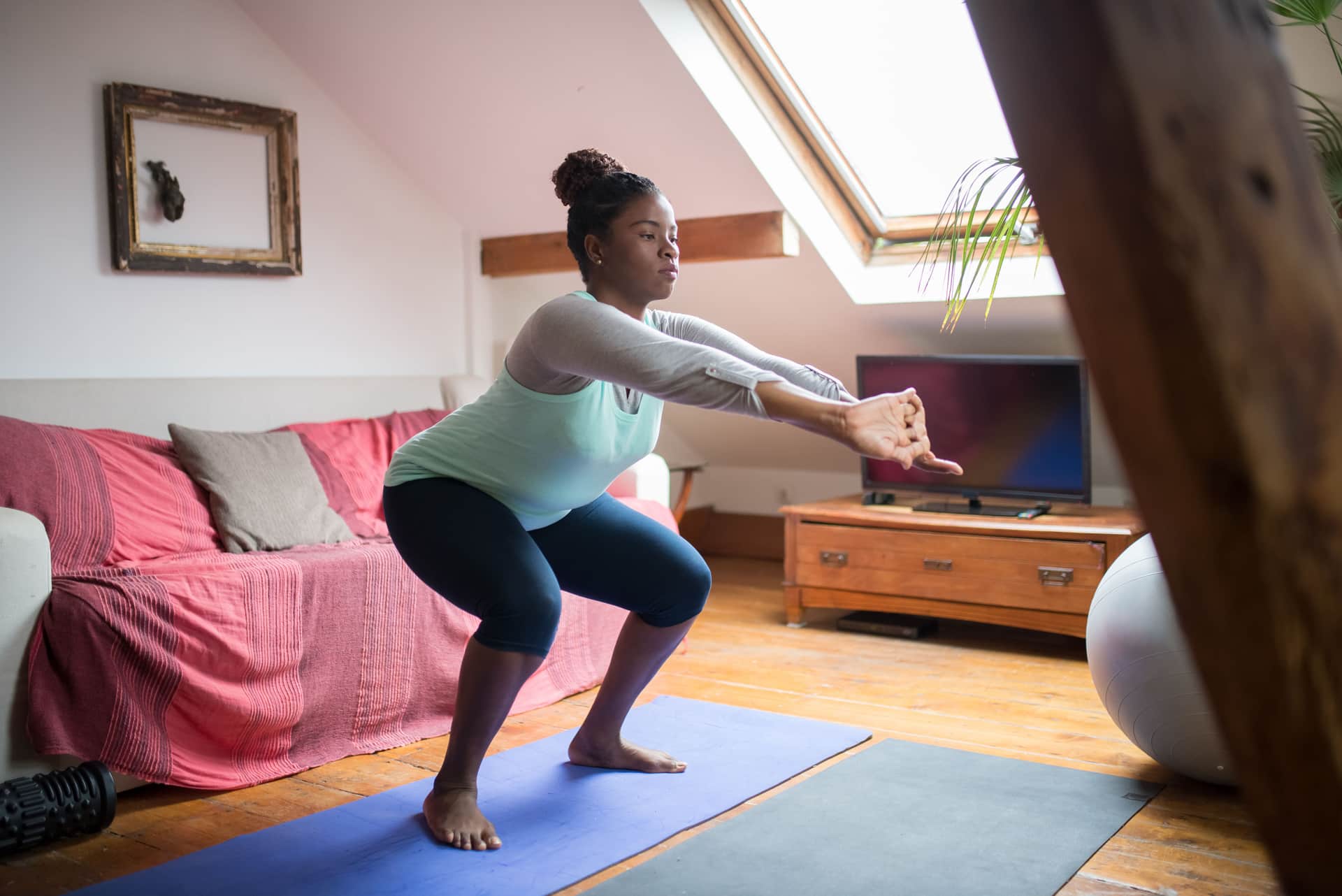
Squat to chair. Feet about shoulder-width, toes slightly out. Push your hips back and sit down under control, then stand up by driving through your whole foot. Knees track over your toes — they can go past your toes; they shouldn't cave inward.
Hip hinge. This is the movement people get wrong most. Soft knees, push your hips straight back as if closing a car door with your backside, keep your back flat, feel a stretch in your hamstrings, and stand up by squeezing your glutes. You are not bending forward from the waist.
Incline push-up. Hands slightly wider than shoulders on a stable surface, body in one straight line from head to heels, lower your chest to the surface, press back up. The higher the surface, the easier.
Row. Hold a doorframe (or a towel looped around a sturdy post), lean back with straight arms, then pull your chest toward your hands by squeezing your shoulder blades together. Your elbows finish by your ribs.
Split squat. Stand in a staggered stance, drop the back knee toward the floor, front shin roughly vertical, then stand. Hold a chair for balance at first.
Glute bridge. Lie on your back, knees bent, feet flat. Push through your heels and lift your hips until your body is straight from knees to shoulders. Squeeze at the top; don't arch your back.
Suitcase carry. Hold something heavy in one hand, stand tall, and walk. The work is in not leaning toward the weight. This is the most underrated core exercise there is.
Dead bug. Lie on your back with arms straight up and knees over hips. Press your lower back into the floor, then slowly lower the opposite arm and leg. If your back arches, you've gone too far.
The ACE Exercise Library has free video demonstrations of most of these if you want to see them in motion.
How to progress over eight weeks
- Weeks 1–2: 2 rounds, easiest versions, two days a week. Goal: learn the movements and finish feeling like you could do more.
- Weeks 3–4: 3 rounds. Add reps to anything that felt easy.
- Weeks 5–6: move one or two movements to the next progression. Add a third day if recovery is good.
- Weeks 7–8: most movements on the second progression; add load with a backpack or jugs. You are now doing real strength training.
After eight weeks, the next step is adding a few pieces of equipment — resistance bands, then one or two kettlebells or a pair of adjustable dumbbells — or getting a coach to take it from here. See strength training coaching and, for how many sessions a week make sense, how often you should work with a personal trainer.
What to do on the other days
Walk. Federal guidelines recommend 150–300 minutes of moderate aerobic activity a week (HHS), and brisk walking counts. If you're in North Dallas, the trails I list on my service area pages — Arbor Hills and Oak Point in Plano, Allen's greenbelts, Bonnie Wenk in McKinney — are ideal. Any activity you accumulate through the day counts toward the total.
Common beginner mistakes
- Going too hard in week one. Being unable to walk on day two is not a badge of honor; it's why people quit.
- Skipping the hinge and the row. They're less familiar than squats and push-ups, and they're the ones that protect your back and posture.
- Never progressing. If the workout feels the same in month three as in week two, you've stopped getting stronger.
- Doing it every day. Muscles grow between sessions. Rest days are training days.
- Training alone forever. Videos can't tell you your knees are caving or your back is rounding. A few coached sessions early on prevents months of bad habits.
Making it harder without buying anything
The most common question after the first few weeks is "what do I do when it gets easy?" Here are the levers, in the order I usually pull them:
- Add reps. Take each movement from 8 to 12 reps before changing anything else.
- Slow it down. A 3-second lowering phase on a squat or push-up makes the same rep much harder.
- Pause. Hold the bottom of a squat, the top of a bridge, or the bottom of a push-up for two seconds.
- Change the angle. Lower the surface for push-ups; lean back further for rows.
- Go single-leg or single-arm. Split squats, single-leg bridges, single-arm rows.
- Add load with what you have. A backpack with books, a jug of water, a bag of groceries. Hold it in a goblet position for squats, at your sides for carries, on your hips for bridges.
- Shorten the rest. Only once the movements are solid — this makes the session harder without changing the exercises.
Progress one lever at a time. If you change three things at once you won't know which one worked.
Warm-up and cool-down, in detail
Warm-up (3–5 minutes). The goal is to raise your temperature and rehearse the movements you're about to do:
- 30 seconds marching in place, then 30 seconds with high knees
- 10 arm circles each direction
- 10 hip circles each direction
- 5 slow bodyweight squats to a chair
- 5 slow hip hinges with hands on hips
- 5 wall push-ups
Cool-down (2–3 minutes). Walk slowly for a minute, then hold each of these for 20–30 seconds: a standing calf stretch against the wall, a hip-flexor stretch in a half-kneel, a chest stretch in a doorway, and a gentle hamstring stretch with one heel on a low step. Breathe slowly through your nose. That's it — cool-downs don't need to be long.
A note on sets, reps, and rest
- Set = one round of an exercise. Rep = one repetition inside that set.
- Beginners do well with 2–3 sets of 8–12 reps for most movements, which is what this routine uses.
- Rest about 60 seconds between exercises in the circuit and 1–2 minutes between rounds. Rest is when your muscles recover enough to do the next set well — skipping it makes the workout worse, not better.
- Finish each set feeling like you could have done one or two more reps. That's the sweet spot for learning and for staying injury-free.
Want this coached?
If you're in Plano, Frisco, McKinney, Allen, Richardson, or Carrollton, I'll come to your home and coach exactly this — then take you far beyond it. Book a free consultation.
How this works with Fit with Meghan
Strength Training in North Dallas
Learn to squat, hinge, push, pull, and carry with proper form, then progress every week. Kettlebells and dumbbells, not a squat rack.
Related questions
Can beginners build strength at home without equipment?
Yes. Squats, hinges, push-ups, rows, split squats, bridges, carries, and core work — done two or three times a week and progressed to harder versions over time — build real strength. Household objects like a loaded backpack add load when bodyweight gets easy.
How many days a week should a beginner strength train?
Two or three non-consecutive days. Federal guidelines recommend muscle-strengthening activity at least two days a week, and beginners progress well on two.
How long should a beginner home workout be?
About 25–35 minutes including warm-up and cool-down: 2–3 rounds of an 8-movement circuit. Longer isn't better for beginners.
When should I add weights?
When the harder bodyweight versions feel easy — usually after 6–8 weeks. Start with resistance bands or a loaded backpack, then a kettlebell or adjustable dumbbells.
Sources
- CDC — Adult Activity: An Overview (physical activity guidelines for adults) — accessed 2026-09-20
- U.S. Department of Health & Human Services — Physical Activity Guidelines for Americans, Top 10 Things to Know — accessed 2026-09-20
- ACE — Exercise Library — accessed 2026-09-20
Not medical advice. The information on this page is educational. Talk with your physician before starting a new exercise program, especially if you have a health condition, are pregnant or postpartum, or have an injury.